Introduction
As a smart entrepreneur, you already know that email marketing needs to be an integral part of your digital marketing strategy. But how do you go about choosing the best email marketing platform for your business? At the time of writing this article, there were over 300 email marketing platforms available on the market. You can't possibly review and test all of them!
You're probably using, or thinking of going with, one of the more popular platforms like Mailchimp or ActiveCampaign. Common advice will tell you to look for the one with the best features. The thing is that the essential features needed to build, manage and grow your list of email subscribers - drag-and-drop editors, form builders, templates, list segmentation, autoresponders, automations, A/B testing, etc. are generally comparable among the top email marketing platforms.
So, if the essential features are similar among the platforms, what should you focus on when deciding which is the right one for you? I suggest that you take a cost-conscientious approach, and in particular look at pricing fairness and hidden costs. You probably didn't even know that many of the popular platforms engage in really unfair practices, which are only revealed to you after you've already committed.
And at that point, migrating to another platform may seem like too much of a hassle... so you continue to take the abuse.
But, looking out for unfair billing and hidden costs is important... such practices eat into your budget significantly, as your list grows. Why should you be punished for growing your business?
In this guide we’ll walk you through the sneaky charges and traps to watch for (understanding the true costs beyond advertised prices), identify platforms with fair billing practices, compare platforms, and after all considerations, reveal which email marketing platforms come out on top for solopreneurs and small businesses. We’ll also address common fears about switching platforms and share money-saving tips.
Ultimately, you'll be in a good position to choose a solution that grows with your business rather than against it.
Email marketing remains the marketing channel with the highest return on investment, averaging $36-42 returned for every $1 spent. Yet choosing the wrong platform can trap your business in escalating costs that grow faster than your revenue.
In recent years, major email marketing platforms, like MailChimp and ActiveCampaign have raised their prices 40-150% and continue to implement unfair billing practices that penalize solopreneurs, small business owners and startups in particular.
But smart entrepreneurs can still find excellent alternatives that prioritize transparent pricing and genuine value over profit maximization.
Understanding Email Marketing Platform Billing Models
Before diving into specific platforms, let's understand how these companies charge you - because the differences can cost thousands annually.
- Contact-based pricing charges you for every email address in your database. This seems straightforward until you discover some platforms charge for unsubscribed contacts, inactive subscribers, and even bounced emails. MailChimp, for example, bills for all contacts regardless of whether they can receive emails - meaning you pay for people who unsubscribed months ago.
- Send-based pricing charges based on how many emails you actually send. This model typically offers better value for businesses with large lists but infrequent sending. Platforms like Brevo use this approach, offering 300 free emails daily regardless of list size.
- Hybrid models combine contact limits with send limits, often creating a little confusion about actual costs. Many platforms advertise low contact-based prices but impose strict monthly email limits that trigger overage charges.
The hidden costs (and unfair billing policies) are not shown on pricing pages, so you often don't know, or are made aware of them. These appear in common traps including charging you for non-subscribers, automatic overage fees, lack of automatic downgrades if your list shrinks, locked features on low-tier plans, and extra support charges. I refer to these as “pricing traps” because they can make a platform that initially seems cheap or affordable quite expensive as you grow.
Now that you have a better understanding of how you'll be billed, let's take a closer look at these hidden costs, and identify the platforms that implement them.
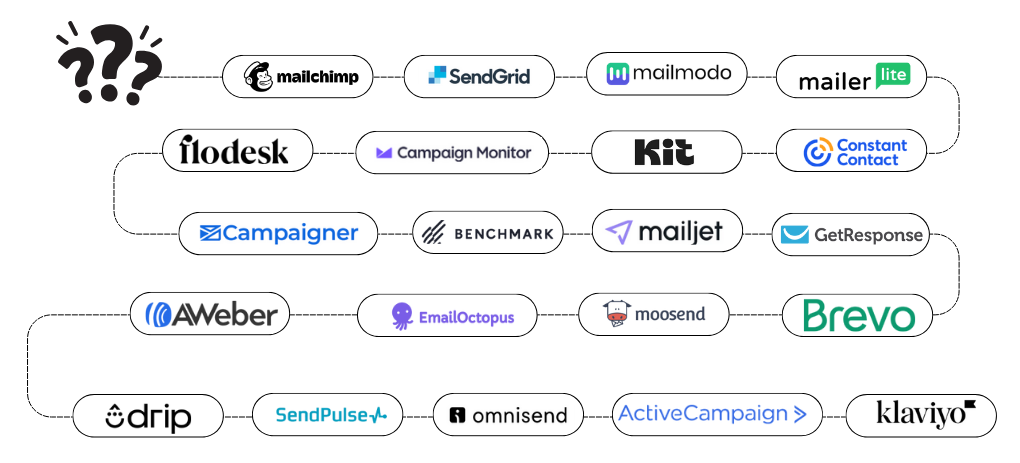
Let's start off with a list of the 21 top and more popular email marketing platforms...
Hidden Costs to Avoid: Filtering Out Unfair Email Marketing Platforms
Let's systematically eliminate platforms based on billing fairness, starting with the most problematic practices.
Platforms charging for inactive subscribers
Some platforms bill you for unsubscribed or bounced addresses unless you clean them up. Mailchimp, for example, explicitly counts unsubscribes toward your total even though they can’t be emailed. In practice that means if you never remove unsubscribed people, your bill keeps rising for contacts you’ll never message.
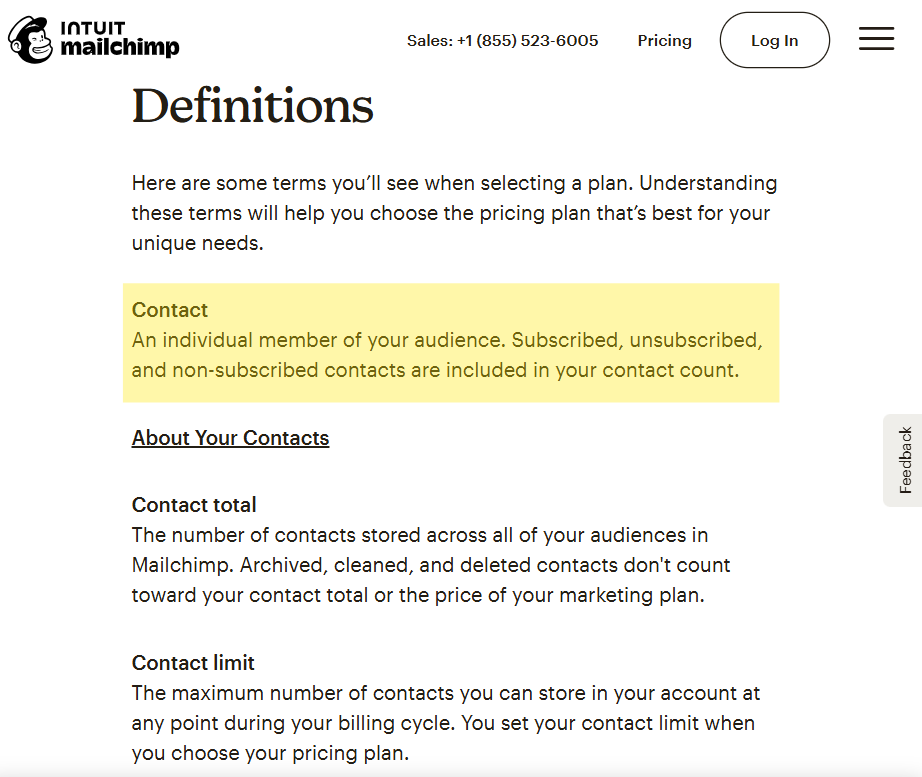
Always confirm how an email marketing platform counts contacts. If unsubscribes or unconfirmed signups still count as contacts, it can drive up costs unfairly. When vetting a platform, check the pricing FAQ or help docs.
So, let's eliminate any tool that bills for unsubscribes. This means that Mailchimp, Aweber, Drip and Mailmodo must go.
Platforms with automatic overage charges
Some platforms quietly add overage charges or automatically upgrade your plan if you exceed your limits. Their policies warn that if you go over your contact or email-sending limit, it will automatically apply extra charges (“blocks of contacts”). That means you could suddenly pay a lot more if your list spikes one month.
Be cautious... even if a plan looks cheap, surprise blocks or upcharges can blow your budget. Several popular email marketing platforms impose hidden overage fees.
If you overshoot your plan, you should get warnings or pause campaigns – not instant charges you didn’t expect. So, check before you buy - does the platform warn you and give you options before billing more? More fair platforms won’t auto-bill in the background; if you hit the limit, they prompt you to upgrade rather than secretly charging your card.
So, in this round Constant Contact, GetResponse, Mailjet, SendGrid and Benchmark are eliminated.
Platforms with poor downgrade policies
Most providers won’t automatically lower your plan if your list shrinks – you have to request it. In practice that means if you delete some contacts or they unsubscribe, your bill stays the same unless you ask to downgrade.
This practice is unfair: you get charged as if your list were still at its peak size. Many big email marketing platforms (ActiveCampaign, Klaviyo, and Kit) automatically upgrade your price when you add subscribers but won’t drop your plan when you remove them. In some instances, you must contact support to downgrade after deleting contacts.
It's only fair that if a service will jack up your price when your list grows, it ought to reverse it when your list shrinks.
Ideally, choose a platform that automatically resizes your tier both up and down as needed – or at least makes downgrading painless. MailerLite, for example, allows you to reduce your subscriber limit (and plan) from your dashboard whenever you want, giving you control. In this round ActiveCampaign, Klaviyo, Kit, as well as Email Octopus and Campaigner are eliminated.
The Email Marketing Platforms That Survive the Elimination Process
After removing platforms with unfair billing practices, seven options remain. These platforms survive because they maintain fair billing practices, don't penalize business growth, and provide genuine value rather than extracting maximum revenue through billing tricks.
Now, let's look at these email marketing platforms through the features that matter - ease of use, cost, templates, deliverability reputation, automation capabilities and support.
Let's start with one of the most important feature...
Deliverability
Email deliverability refers to the ability of an email message to successfully reach a recipient's inbox, avoiding spam filters and other obstacles. Deliverability is important because if your emails aren’t getting delivered, then no amount of good copywriting, building relationships or anything else will help you generate sales.
Based on test undertaken by independent company EmailToolTester, here are the deliverability scores for our top email marketing platforms:
- Brevo - 88.3%
- MailerLite - 89.8%
- Flodesk - Not tested, and I haven't been able to find any other independent test results.
- Omnisend - 75.1%
- Moosend - 90.1%
- Campaign Monitor - Not tested
- SendPulse - 62.8%
According to EmailToolTester, an email deliverability rate of over 89% is considered good. Because of how critical email deliverability is, you definitely want to go one of the platforms that score high - Brevo, MailerLite and Moosend.
Ease of Use
If you’re not a techie, pick something with a drag-and-drop email builder and simple automation workflows. You’ll save hours on training. Luckily, these email platforms all have fairly intuitive interfaces. SendPulse's email editor is reported as being clunky, while MailerLite and Brevo are often praised for their clean interfaces and beginner-friendly editors.
Automation Capabilities
Most successful campaigns use automations (welcome series, follow-ups, cart reminders, etc.). Even “basic” automations (single-trigger sequences) should be included without forcing an upgrade. MailerLite, ActiveCampaign, and Brevo all offer flexible automations, but note that some cheap plans at competitors (like GetResponse, ActiveCampaign’s starter) severely limit the number of workflows or steps unless you pay more
Pre-Designed Email Templates and Forms
You’ll want at least a decent gallery of responsive email templates and sign-up form types (popups, embedded forms, landing pages, etc). Fortunately, most email marketing platforms provide a decent collection of templates.
Support
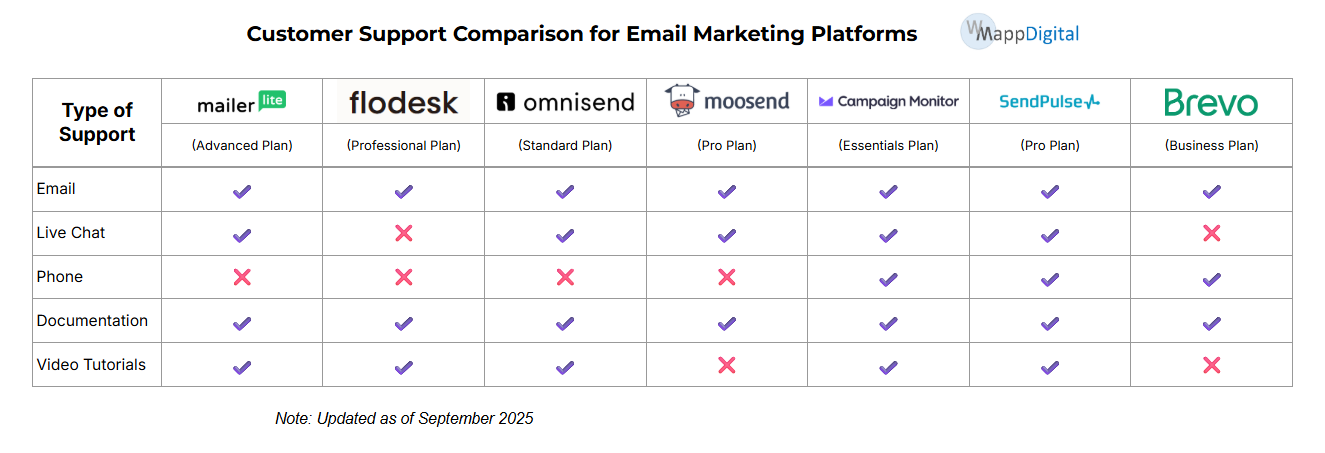
If email marketing is new to you, and especially if you're not too tech-savvy so that you can troubleshoot problems, or you just don't want to have to spend the time, they you have to ensure that support from the email marketing platform is easily available and actually helpful. You'll want to go with a platform that provides proper documentation and tutorials, but more importantly email and live chat support.
Pricing Comparison
Now let's look at the pricing of our top platforms based on the number of contacts on your list...
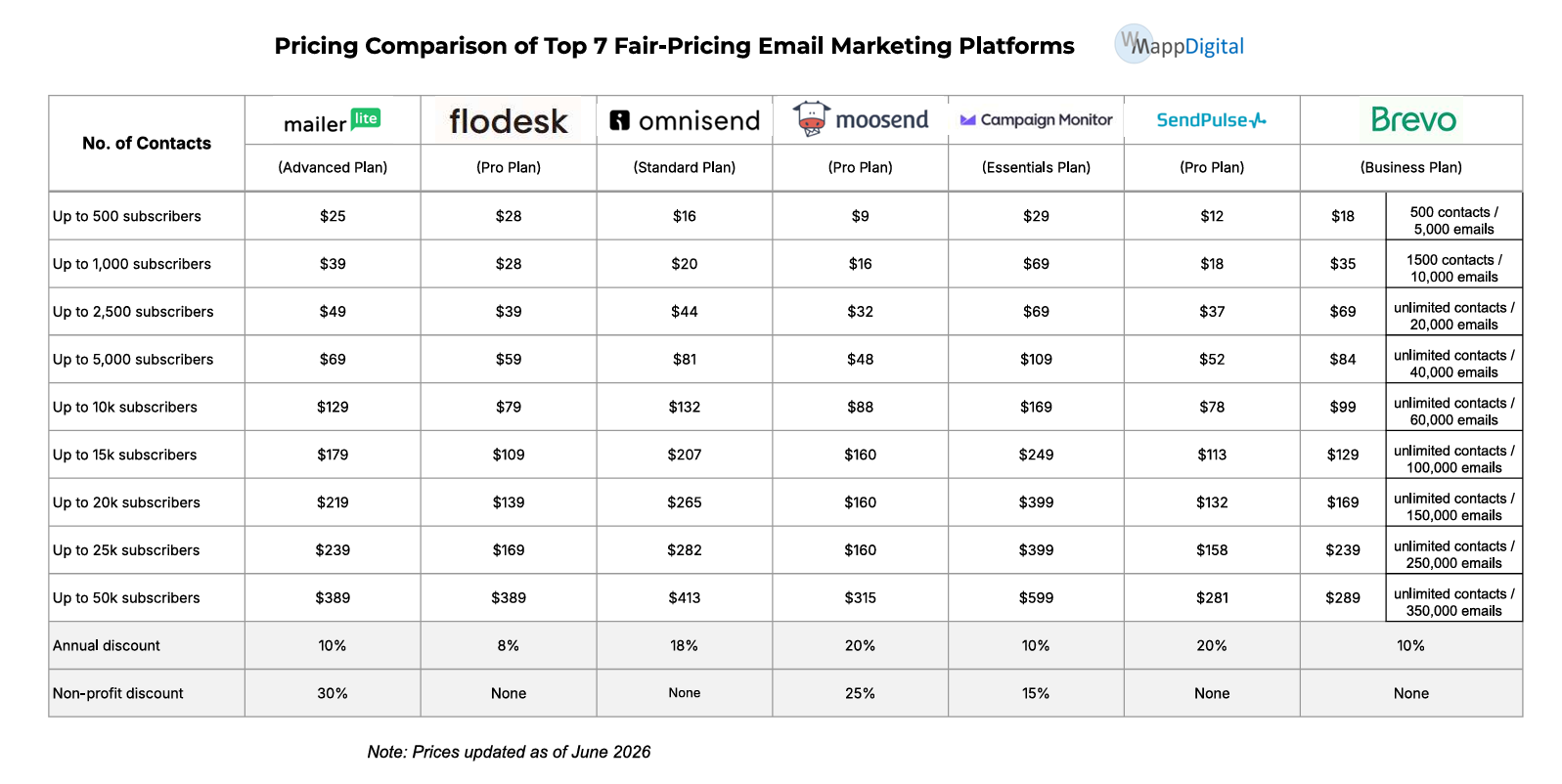
From this comparison, MailerLite, Moosend and SendPulse offer the best pricing as your list grows. Brevo, which is based on the number of emails you send per month, rather than on the number of contacts is also good.
Flodesk, which up till 2025 offer a flat rate no matter how large your list was, recently changed their pricing to be based on list size.
But, Flodesk is said to lack some advanced features, such as automations with multiple triggers and email testing (e.g. A/B testing, spam tests). Also, Flodesk only offers email support and there’s no chat or phone support available.
Why MailerLite dominates for small businesses and solopreneurs
In many reviews and comparisons, MailerLite emerges as a top pick for small businesses and solopreneurs. Why? MailerLite offers a winning combination of fair pricing, comprehensive features, and genuine customer focus.
Let's take a closer look...
- No hidden subscriber fees. MailerLite’s pricing only counts active contacts. Unsubscribed or bounced addresses are excluded from your bill. In practice, this means you can safely clean your list or have people opt out, without fearing they’ll keep charging you.
- Transparent plans. MailerLite shows exactly what’s in each tier. The cheapest plan already includes unlimited emails, landing pages, automation workflows, RSS campaigns, A/B testing, and more. If you do need extras like advanced automations, HTML editor or pop-ups, they’re available on the next tier – but the jump is clearly marked in pricing.
- Fair migrations and support. MailerLite offers assistance for new users. They even have a “migration pack” with tutorials and personalized help to switch from other platforms. During its free trial you get full 24/7 support, so you can ask questions as you move your data.
- Great user-experience for non-technical users. Many users praise MailerLite’s clean dashboard and drag-and-drop editor, requiring little learning curve. The automation builder is also very good and easily handles welcome sequences and customer journeys. The interface won "Best Email Marketing Tool For Ease of Use" awards in 2023, 2024, and 2025.
- Strong deliverability. MailerLite maintains an excellent sending reputation. In independent deliverability tests, MailerLite consistently outperformed or matched bigger brands. Their strict authentication process and anti-spam policies protect all users' sender reputations.
- Budget-friendly. MailerLite’s pricing scales gently. Even the free plan is relatively generous (up to 250 subscribers and 2500 emails/month). Paid plans start at just $12/month for 500 contacts and unlimited emails sends. MailerLite offers annual billing discounts (10% off when you pay yearly) and also gives nonprofit discounts if you qualify.
- The pricing advantage is substantial. MailerLite costs significantly less than less than platforms like ActiveCampaign and MailChimp for comparable features while offering unlimited sending on all paid plans. For example, if you have 5000 contacts on your list, MailChimp charges $100 monthly with send limits, while MailerLite charges $69 with unlimited sends (that's 30% less!).
- Their feature set rivals enterprise platforms. The free plan, though limited to 500 contacts, includes marketing automation, landing pages, website builder, and pop-up forms - features that cost extra elsewhere. Paid plans add unlimited users, AI writing assistance, and advanced segmentation starting at just $12 monthly. Recent updates include smart sending optimization, multivariate A/B testing, and an AI-powered content assistant.
- Customer support maintains a 97% satisfaction rate with 24/7 availability on paid plans. Unlike competitors charging extra for support, MailerLite includes comprehensive assistance in their base pricing. User testimonials consistently highlight value and reliability.
- Integration capabilities cover 140+ popular tools including Shopify, WordPress, Canva, and Zapier connections to 5,000+ additional apps.
The bottom line is MailerLite delivers the core features most solopreneurs and small businesses need without the usual upcharges.
Is Migration Really Worth It: Overcoming Migration Hesitations and Objections
Many people hesitate to leave their current email marketing platform, even if they’re unhappy with the costs. The biggest barrier to switching platforms isn't technical - it's psychological. So, let's address the most common concerns that keep businesses trapped with expensive providers.
"Data migration sounds too complicated... Wouldn't I lose data and subscribers?"
This ranks as the top concern, with 68% of entrepreneurs nervous about the time required to migrate from one platform to another. But, the reality is less daunting than perceived.
You’ll need to export and import your lists, forms, and maybe campaigns. Fortunately, modern platforms provide migration tools to help. MailerLite, for example, offers detailed guides on transferring from popular platforms (Mailchimp, Constant Contact, ActiveCampaign, etc.). They even have “migration packs” with step-by-step tutorials and tips.
The key is to import only active, opted-in contacts (and keep your unsubscribes unimported to avoid compliance issues). This is actually a good time to clean your list of hard bounces and uninterested leads – something you probably should have done anyway. A fresh import of warm contacts can improve your deliverability.
"I'll lose my email templates and automations"
This concerns many business owners who've invested time in customization. While you’ll likely need to rebuild your emails and workflows in the new system, this can be taken as an opportunity for improved designs and performance: migrating forces you to take inventory of what you have, update your branding, and discard outdated content, etc.
Many platforms let you copy-paste HTML or use similar drag-drop editors, and landing page forms. If your automations were cluttered, you can redraw them more cleanly. It's recommended documenting and gathering all your templates, images, and programs before moving – once you have that plan, the actual switch is straightforward.
"My team will need retraining"
This assumes significant learning curves, but platforms prioritizing user experience minimize this challenge. MailerLite's intuitive interface requires minimal training compared to complex enterprise platforms. The temporary productivity loss is quickly offset by the platform's efficiency gains and cost savings.
"Integration disruptions will break our workflows"
This represents a legitimate concern and requires careful planning. The solution is gradual migration rather than sudden switches. Maintain both platforms briefly during transition, test integrations thoroughly, and migrate subscriber segments progressively. Most integration issues resolve within days, while billing savings continue for years.
"What if deliverability suffers during transition?"
This concern has merit but also has manageable solutions. New sending IP addresses require "warming up" with gradually increasing send volumes to most engaged subscribers first. MailerLite's excellent deliverability reputation (89.8% inbox placement) often improves delivery rates compared to previous platforms.
The bottom line ... Migration pays off!
The psychological trick is reframing migration from a cost to an investment. Businesses staying with expensive platforms lose more money monthly than migration costs entirely. you’ll be freeing yourself from unfair charges and complicated billing.
Many entrepreneurs admit that once they switched to more cost-effective platforms, the peace of mind was worth the short transition.
Email Marketing Cost-saving Tips and Hidden Discounts
Once you pick a platform, you can still trim your costs further. Here are a few tips:

- Pay Annually: Almost every platform offers a discount for annual billing. MailerLite, for example, gives 10% off if you pay yearly, while Moosend and SendPulse offer 20%. That often equates to getting 1-3 months free. If you know you’ll be using the service at least a year (which most do), take advantage. Even more, platforms sometimes run promotions (like holiday sales) with even steeper discounts. Plan your signup around those if you can.
- Nonprofit and Agency Discounts: If you qualify, ask for special pricing. MailerLite offers one of the best email marketing platforms for nonprofits with a 30% discount, while Campaign Monitor offers a 15% discount. Some agencies can also get developer or bulk discounts. It never hurts to ask sales if they have any programs for your situation.
- Avoid Paying for Unused Features: Don’t buy a plan just because it’s “recommended” or includes a feature you won’t use. For example, you might only need simple one-off emails and basic drip autoresponders, but some plans push you to buy advanced CRM integrations or phone support you’ll never touch. Only upgrade when features will drive revenue (e.g. cart abandonment for an ecommerce store, or advanced automation for a product funnel).
- Regularly Clean Your List: This isn’t a platform trick, but it saves money. Remove hard bounces, invalid emails, and truly inactive subscribers. A lean list of engaged contacts will improve engagement rates and, on platforms that count contacts, can let you drop to a lower tier.
Making Your Decision When Choosing (or Migrating to) an Email Marketing Platform
Choose your email marketing platform by prioritizing billing fairness, feature adequacy, and growth accommodation over brand recognition or advanced features you may never use.
The decision framework is straightforward:
- Calculate total monthly costs including hidden fees
- Evaluate billing fairness and transparency
- Test user experience during free trials
- Project expenses as your business grows
Platforms with fair practices, transparent pricing, and generous free plans indicate customer-focused business models that align with your long-term interests.
Migration timing matters less than platform choice. Every month with an expensive, unfair platform costs more than migration efforts. Start your new platform account as soon as possible, begin the migration process, and enjoy the satisfaction of supporting businesses that treat customers fairly.
The email marketing platform landscape has revealed which companies genuinely support small business success versus those that view customers as revenue extraction opportunities. Choose accordingly, and your future self will thank you for the thousands saved and headaches avoided.
Conclusion
Choosing an email marketing platform isn’t just about features; it’s about value and fairness.
Some established players continue to implement increasingly aggressive and unfair billing practices while alternatives offer superior value through transparent pricing and customer-focused features.
Major platforms like MailChimp, ActiveCampaign, and AWeber have prioritized profit extraction over customer value through billing tricks, surprise price increases, and essential feature restrictions. Meanwhile, platforms like MailerLite, Brevo, MooSend and a few others have gained market share by maintaining fair practices, generous free plans, and transparent pricing that grows reasonably with businesses.
For solopreneurs and small business owners, the choice has never been clearer. Avoid platforms that charge for inactive subscribers, implement automatic overage charges, restrict downgrades, or lock essential features behind expensive tiers. Choose providers that demonstrate customer focus through fair billing, comprehensive free plans, excellent support, and transparent pricing.
By focusing on how providers charge – for contacts, for extra features, and for support – you can avoid the expensive surprises that trap many growing businesses.
MailerLite emerges as the standout choice for most small businesses, offering significant cost savings compared to major competitors while providing superior features, deliverability, and user experience. And, the migration process, while requiring some effort, pays for itself within the first month through billing savings and often improves email marketing performance.
Happy emailing, and here’s to fair pricing and full inboxes!
Frequently Asked Questions
What is the cheapest email marketing platform for small businesses?
MailerLite offers the best value for small businesses, with a free plan supporting 250 subscribers and 2500 monthly emails, plus paid plans starting at $12/month with unlimited sending. While other platforms may advertise lower prices, they often charge for inactive subscribers or impose strict sending limits that increase actual costs. Avoid platforms like MailChimp that now charge for unsubscribed contacts, which can double your monthly expenses.
Which email marketing platforms charge for inactive subscribers?
MailChimp is the primary offender, charging for ALL contacts including unsubscribed and bounced email addresses since April 2024. This practice can significantly inflate costs as inactive contacts accumulate over time. In contrast, platforms like MailerLite, Brevo, and Moosend only charge for active, engaged subscribers, making them much more cost-effective for businesses focused on list quality over quantity.
What's the best alternative to MailChimp in 2026?
MailerLite is the top MailChimp alternative, offering significant cost savings with comparable features, unlimited sending, and fair billing practices. Other excellent alternatives with good deliverability scores are Brevo and Moosend. All these platforms avoid MailChimp's problematic practice of charging for inactive subscribers while providing better user experiences and customer support.
How do I migrate from my current email marketing platform?
Platform migration is simpler than most businesses expect and typically takes 2-4 weeks. Most platforms like MailerLite offer free migration assistance and step-by-step guides. Key steps include: 1) Export your subscriber lists and templates, 2) Set up your new account and import contacts, 3) Recreate essential email templates, 4) Test integrations and automations, 5) Gradually transition sending to the new platform. The temporary effort saves thousands annually in reduced costs.
Which email marketing platform has the best free plan?
MailerLite offers a generous free plan with 250 subscribers, 2500 monthly emails, automation features, landing pages, and website builder - far superior to MailChimp's reduced free plan (250 contacts, limited features). Brevo provides 300 daily emails regardless of list size, making it excellent for businesses with large lists but infrequent sending. Most other "free" plans are too restrictive for serious business use.
Do email marketing platforms automatically upgrade your plan?
Yes, many platforms automatically upgrade you without permission, which is why choosing ethical providers matters. MailChimp, ActiveCampaign, and Klaviyo force automatic upgrades when you exceed limits, then require contacting support to downgrade. MailerLite, Brevo, and EmailOctopus provide warnings before upgrades and make plan changes easy. Always choose platforms that respect your budget control rather than maximizing their revenue through billing tricks.
What email marketing features do small businesses actually need?
Essential features include drag-and-drop email builder, mobile-responsive templates, basic automation (welcome series, abandoned cart), list segmentation, A/B testing, integration with your website/CRM, and reliable deliverability. The advanced features most small businesses don't need include complex CRM systems, webinar hosting, SMS marketing, or advanced analytics. Focus on platforms like MailerLite that excel at core email marketing rather than expensive advanced solutions that inflate costs.
How important is email deliverability when choosing a platform?
Deliverability is crucial - the best email content is worthless if it doesn't reach inboxes. Look for platforms achieving 85%+ inbox placement rates, like MailerLite, Brevo and Moosend. MailerLite maintains 89.8% deliverability, outperforming many expensive alternatives. Avoid platforms with poor sender reputations or those that don't provide deliverability data. Good deliverability depends on platform infrastructure, authentication protocols, and list quality - all areas where transparent platforms typically outperform those focused on rapid growth through billing tricks.
Can I switch email marketing platforms without losing subscribers?
Yes, you can migrate your entire subscriber list when switching platforms. Email subscribers belong to your business, not the platform. Most reputable platforms provide export tools for your contact lists, email templates, and basic analytics. While you may need to recreate some automations and designs, subscriber data transfers completely. The key is choosing a destination platform with import tools and migration support - another reason why user-focused platforms like MailerLite provide superior long-term value.