What every all-in-one platform actually replaces, what it doesn't, and why the smartest move for most coaches and service businesses isn't switching platforms — it's switching how you access the one that already wins.
Introduction: Why You're Searching for a "GoHighLevel Alternative"
If you've landed here searching for a GoHighLevel alternative, you're probably in one of a few camps.
- Maybe you tried HighLevel (or GoHighLevel, as it's often called) and got overwhelmed by the sheer size of the platform.
- Maybe an agency sold you on it and then disappeared, leaving you with a half-built sub-account and no idea what to do next.
- Or maybe you're just starting your research and want to know whether HighLevel is even the right foundation before you commit.
All of those are fair reasons to be here. So let's do this properly.
In this guide, we're going to:
- Explain what HighLevel actually is and what it includes
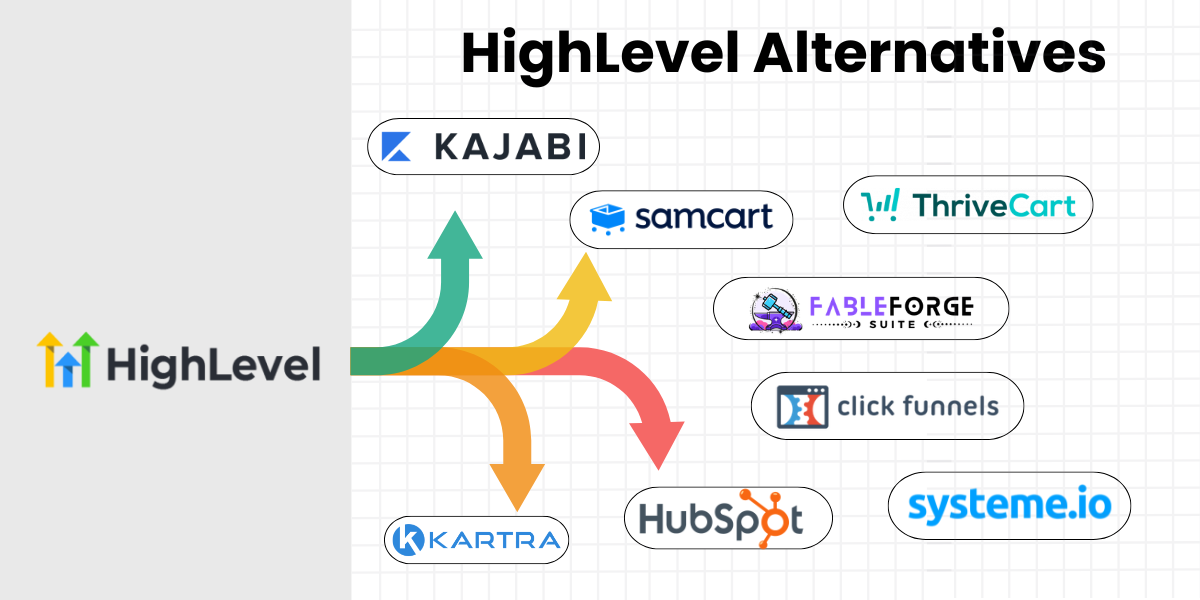
- Do a genuinely thorough, feature-by-feature comparison against the other major all-in-one platforms, namely Kartra, Systeme.io, ClickFunnels, ThriveCart, SamCart, Kajabi, and HubSpot
- Be honest about where HighLevel wins and where it doesn't
- Explain the real reason so many HighLevel users end up frustrated (and it usually isn't the software itself)
- Introduce a genuinely better way to access everything HighLevel does well, without the parts that make people go looking for an "alternative" in the first place
TL;DR: Key Takeaways
Feature-for-feature, HighLevel is, the most complete all-in-one business platform on the market for coaches, consultants, agencies, and service-based businesses. The other similar platforms including Kartra, Kajabi, ClickFunnels, System.io, HubSpot and others genuinely don't match HighLevel's combination of CRM, funnels, email/SMS, automation, booking, courses, reputation management, and white-label flexibility, all under one login.
The problem isn't HighLevel the software. It's HighLevel the experience of signing up on your own: a blank dashboard, a genuinely steep setup curve, and support that's built for developers and agencies, not for a solopreneurs and small business owners who just want the tech behind their business to just work.
That's exactly the gap FableForge Suite was built to close — the same HighLevel engine, pre-configured with real templates, expert-built snapshots, and live human support.
If you want the short version: don't leave HighLevel behind. Just stop trying to build it alone.
What Is HighLevel? A Quick Overview
HighLevel (commonly written as GoHighLevel or "GHL") started as a platform built specifically for marketing agencies who needed to manage client CRMs, campaigns, and websites from one back end, with the ability to white-label and resell it to their own clients.
Over the past several years, it has grown into something far bigger: a genuine all-in-one operating system for running an online business, that includes:
- CRM & pipeline management — track every contact, conversation, and deal stage in one place
- Website, funnel & landing page builder — a visual, drag-and-drop editor for building full site ecosystems
- Email, SMS & voice marketing — send and automate messages across every channel from one inbox
- Workflow automation — build if-this-then-that sequences that handle follow-up, tagging, and task creation automatically
- Booking & appointment scheduling — a built-in calendar system that replaces Calendly or Acuity
- Courses & memberships — host and deliver paid content and programs
- Reputation management — automated review requests and review monitoring
- Social media planning — schedule and publish posts across major platforms
- Unified inbox — every customer conversation (email, text, DM, chat) in one place
- White-label & SaaS mode — agencies can rebrand the entire platform and resell it under their own name
All of HighLevel's three official plans include unlimited contacts, unlimited users, a full CRM, funnel builder, automation tools, email marketing, a booking calendar, reputation management, and course hosting.
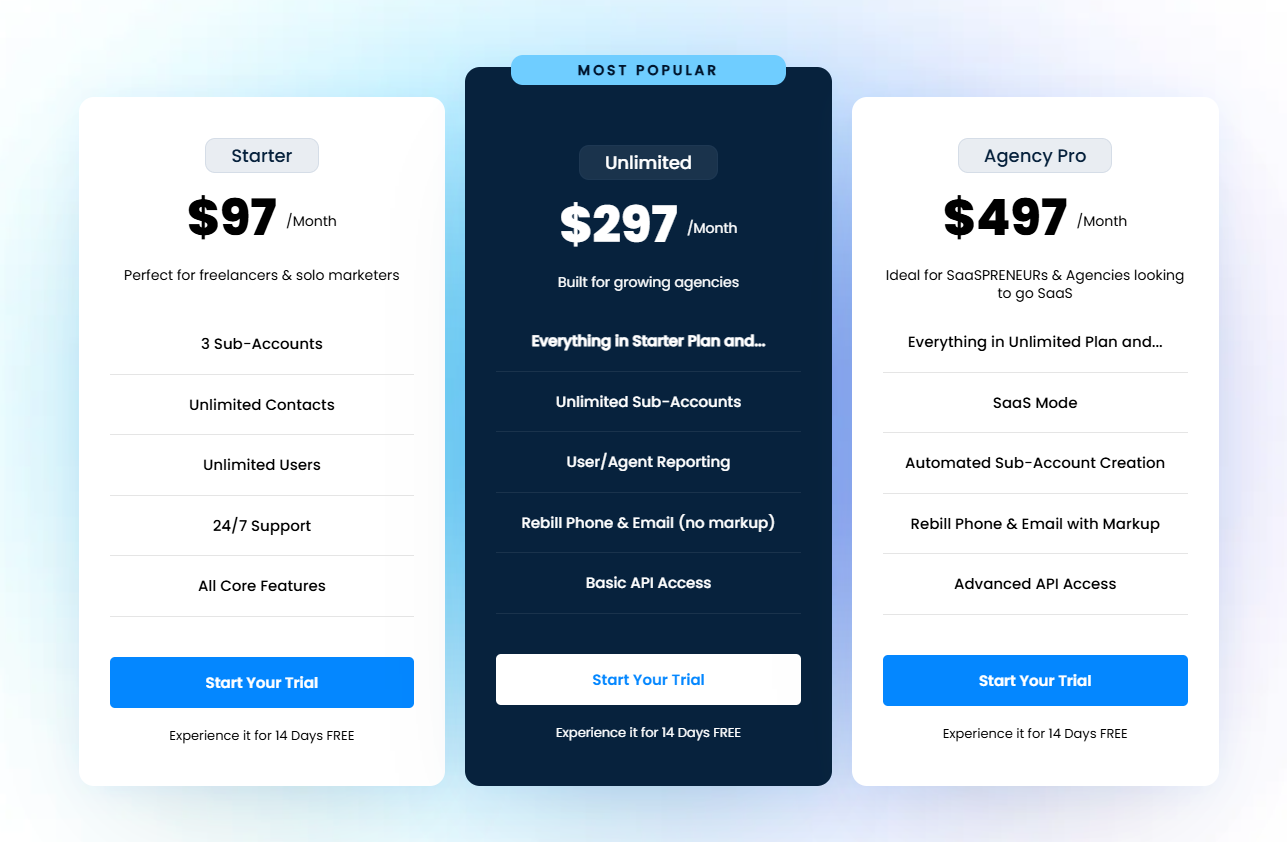
Pricing in 2026 breaks down into three tiers:
- Starter at $97/month
- Unlimited at $297/month, and
- Agency Pro at $497/month
with annual billing bringing the effective monthly cost down to roughly $80, $247, and $414.
The Starter tier gives access to nearly the entire feature set, but it's limited to a single business — you can't add separate client sub-accounts on that plan.
Two things are worth knowing before you commit. First, email, SMS, and voice usage are billed on top of the plan price, so your real monthly cost depends on how much messaging volume your business sends.
Second, SaaS Mode lets you resell HighLevel under your own brand entirely, setting your own pricing and billing clients directly through Stripe — powerful for agencies, irrelevant if you're just running your own coaching or service business.
The bigger catch, and the one nobody puts on the sales page: setup for a new HighLevel account is a high learning curve, especially for a non-techie building it from scratch. That's not a knock on the software — it's a reflection of how much is actually in there. But it's the single biggest reason people start Googling "HighLevel alternative" just weeks after signing up.
HighLevel vs. the Other All-in-One Platforms: A Thorough Comparison
To be a genuine HighLevel alternative, a platform needs to actually compete as an all-in-one business operating system — not just a page builder, not just a checkout tool, not just an email service with a funnel builder bolted on. Platforms that meet that challenge include:
- Kartra
- Systeme.io
- ClickFunnels
- ThriveCart
- SamCart
- Kajabi
- Hubspot
But, let's see how these platforms actually stack up against HighLevel.
HighLevel vs. Kartra
Kartra is probably HighLevel's closest philosophical competitor in this list — it genuinely tries to be an all-in-one hub covering funnels, email, checkout, memberships, and scheduling under a single login.
Kartra's entry plan starts at $119/month, and its marketing automation, tagging, and segmentation cover most of what a solopreneur needs from an email platform, though high-volume senders may want more deliverability control than a bundled tool provides.
Where Kartra falls short of HighLevel: it has no native SMS or voice channel, no white-label/agency resale model, and its CRM is built for marketing funnels rather than the pipeline and sales-team management HighLevel supports. Kartra is a strong, cost-effective choice for a solo course creator or service provider who only needs funnels, email, and checkout. It isn't built to run an agency or a multi-channel sales operation the way HighLevel is.
HighLevel vs. Systeme.io
The biggest selling point for Systeme.io is its free tier — the free plan covers 2,000 contacts, unlimited marketing emails, sales funnels, online courses, an affiliate program, and a booking calendar, with no credit card required. That makes it a genuinely great starting point for someone testing an idea with zero budget.
But Systeme.io's simplicity is also its ceiling. It has no CRM pipeline in the traditional sense, no SMS/voice marketing, no reputation management, and no white-label capability.
It's an excellent "training wheels" platform for a brand-new solopreneur. It is not built to scale into the kind of multi-channel, automation-heavy operation that HighLevel supports once a business has real sales complexity — multiple lead sources, a sales team, or clients of its own to serve.
HighLevel vs. ClickFunnels
ClickFunnels remains the best-known name in funnel building, and it has genuinely improved its page-builder speed and visual funnel mapping in recent versions. Pricing in 2026 runs $97/month for the Startup plan and $297/month for the Pro plan, with roughly 17% savings on annual billing.
The gap between ClickFunnels and HighLevel is structural, not cosmetic. ClickFunnels still lacks native video hosting, a built-in helpdesk, and the depth of email automation that competitors with a true visual sequence builder provide. There's also no native CRM pipeline, no SMS marketing, no booking calendar, and no reputation management. ClickFunnels is a genuinely excellent tool if funnel design and one-click upsells are 90% of your business model. It was never built to be the operating system for the rest of it.
HighLevel vs. Kajabi
Kajabi is the platform of choice for creators who want a polished, design-forward course and membership experience. Kajabi remains a top choice for content-heavy businesses, though a recent price increase to $179/month for the Basic plan has made it harder to justify for many solopreneurs. Its course builder, community features, and content delivery are genuinely best-in-class for a pure knowledge-commerce business.
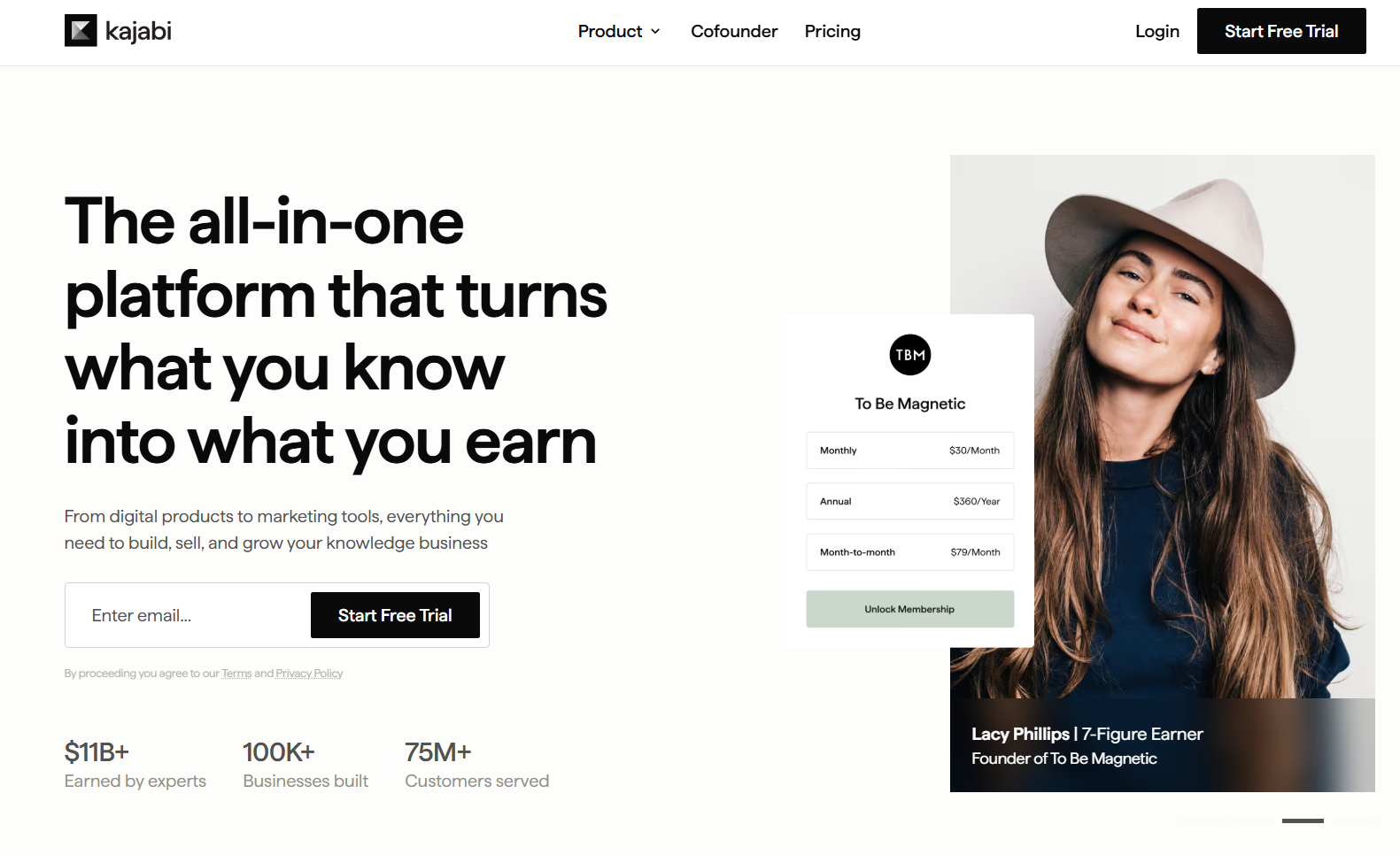
Where it comes up short as a HighLevel alternative: Kajabi's affiliate management system is robust, but its focus stays on content delivery and creator experience rather than sales pipeline management, SMS/voice marketing, or agency-style white-labeling. If your business is 100% "sell a course," Kajabi's design polish is a real advantage. If your business also involves sales calls, lead nurturing, appointment booking, or client management beyond course delivery, you'll be adding tools around Kajabi rather than running everything from it.
HighLevel vs. HubSpot
HubSpot is in a different weight class in one specific way: enterprise-grade CRM depth and reporting. It's also, by a wide margin, the most expensive platform on this list once you move past its free tier. HubSpot's CRM is free forever for unlimited users, and Starter plans begin at $20 per seat per month across all hubs — but Marketing Hub Professional starts at $890/month for just three seats. Hidden costs commonly include onboarding fees of $3,000 to $7,000, and a business running CRM, Marketing, and Sales Pro across 20,000 contacts should expect to pay $3,000–$7,000 per month.
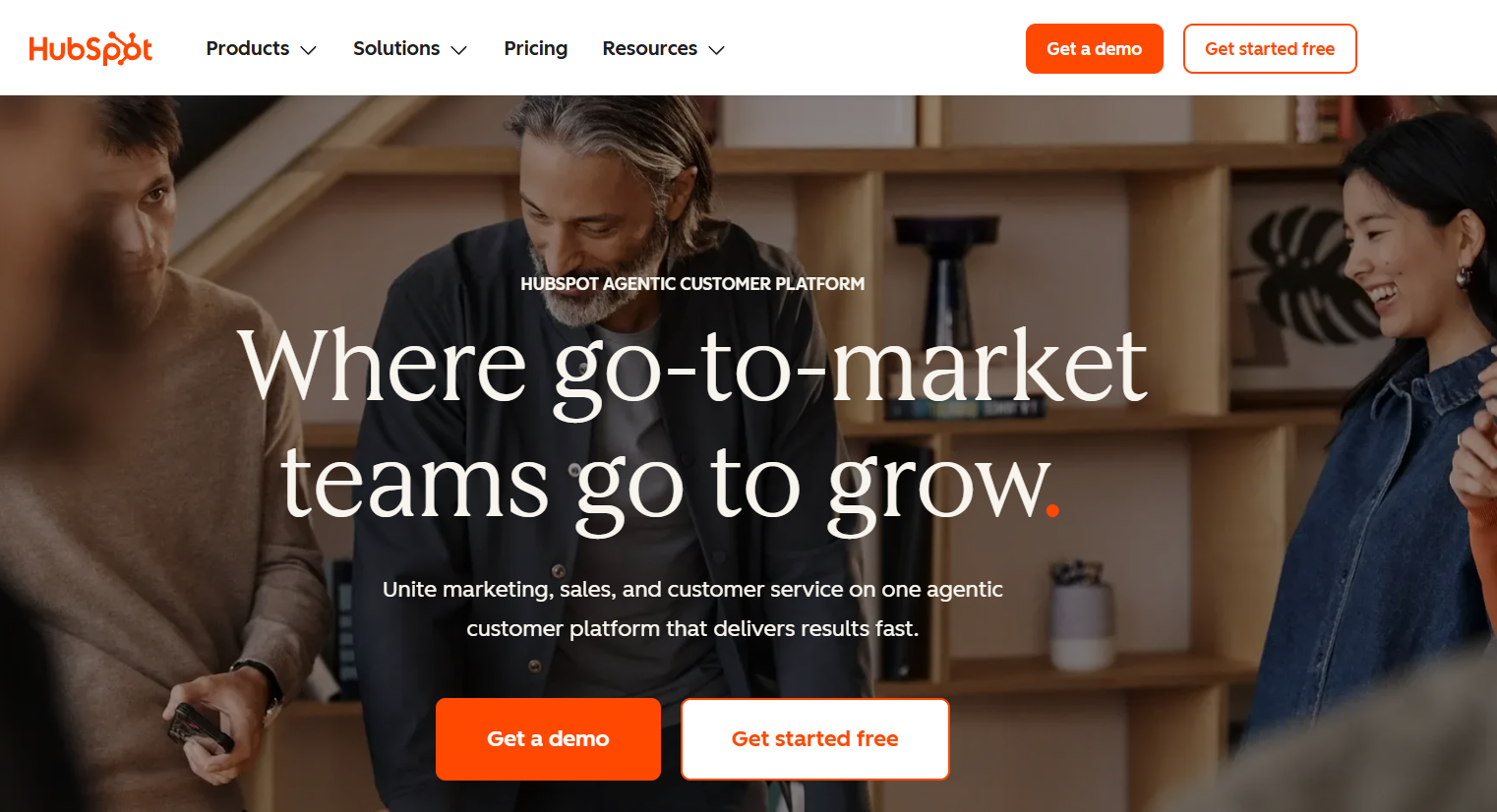
HubSpot's free CRM is genuinely excellent, and its Starter tier is fair value for a small sales team. But the jump from Starter to Professional is roughly a 44-times increase in cost, and HubSpot has no funnel builder, no course hosting, no booking calendar built for client-facing service businesses in the way HighLevel does. HubSpot is built for scaling sales and marketing teams inside larger organizations. It was never designed as an all-in-one platform for a solo coach or small service business, and its pricing structure makes that abundantly clear the moment you need real automation.
HighLevel vs. ThriveCart & SamCart
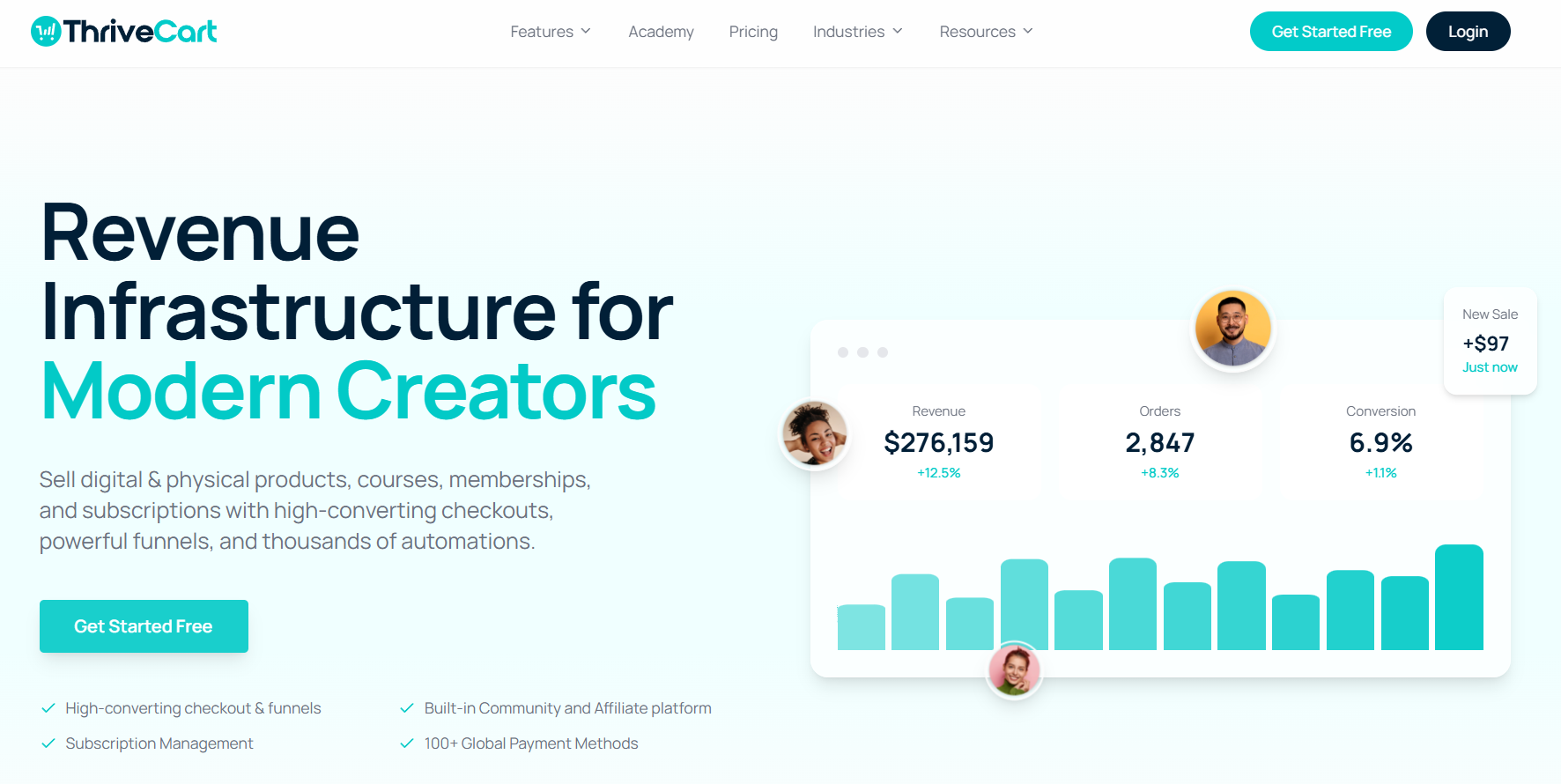
These two get grouped together because they solve a narrower problem: checkout and cart optimization ThriveCart charges a $47/month for its Standard plan, covering checkout, upsells, and order bumps, with things like revenue optimization, affiliate management, advanced customization, and courses/communities are offered on its Pro+ plan which is $87/month.
SamCart starts at $79/month on a single unified plan that scales with revenue, and is purpose-built for checkout optimization — it doesn't include marketing email, multi-step funnels, a website builder, or a community platform.
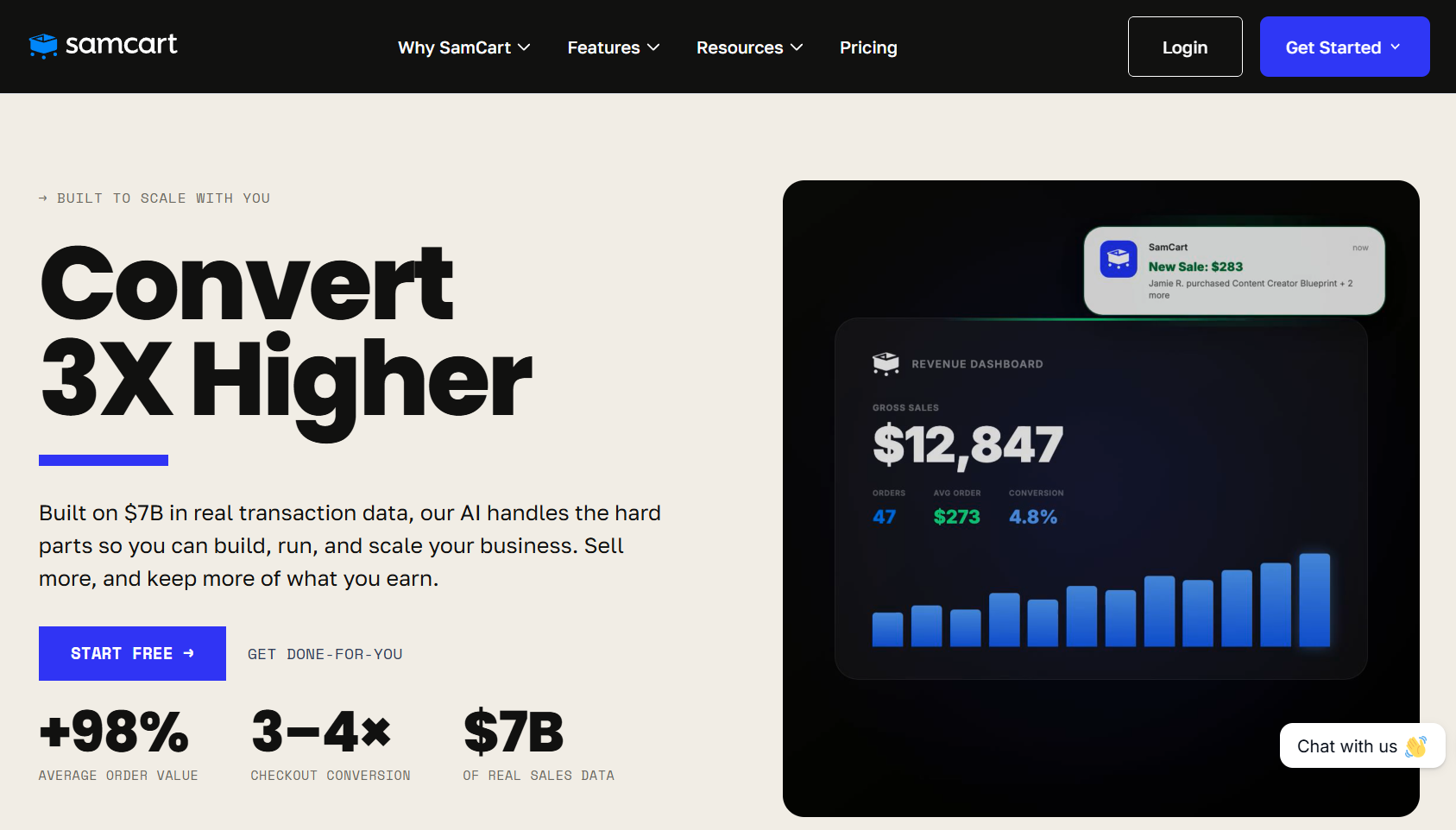
Both are genuinely good at the one thing they do. But, neither one is trying to be an all-in-one platform, and it shows: no CRM, no email marketing, no automation builder, no booking calendar. If you already have a full tech stack and just need a better checkout page, ThriveCart is worth a look. If you're comparing them to HighLevel as a full business platform, it's not really an apples-to-apples comparison — they're a single tool wearing an all-in-one platform's search terms.
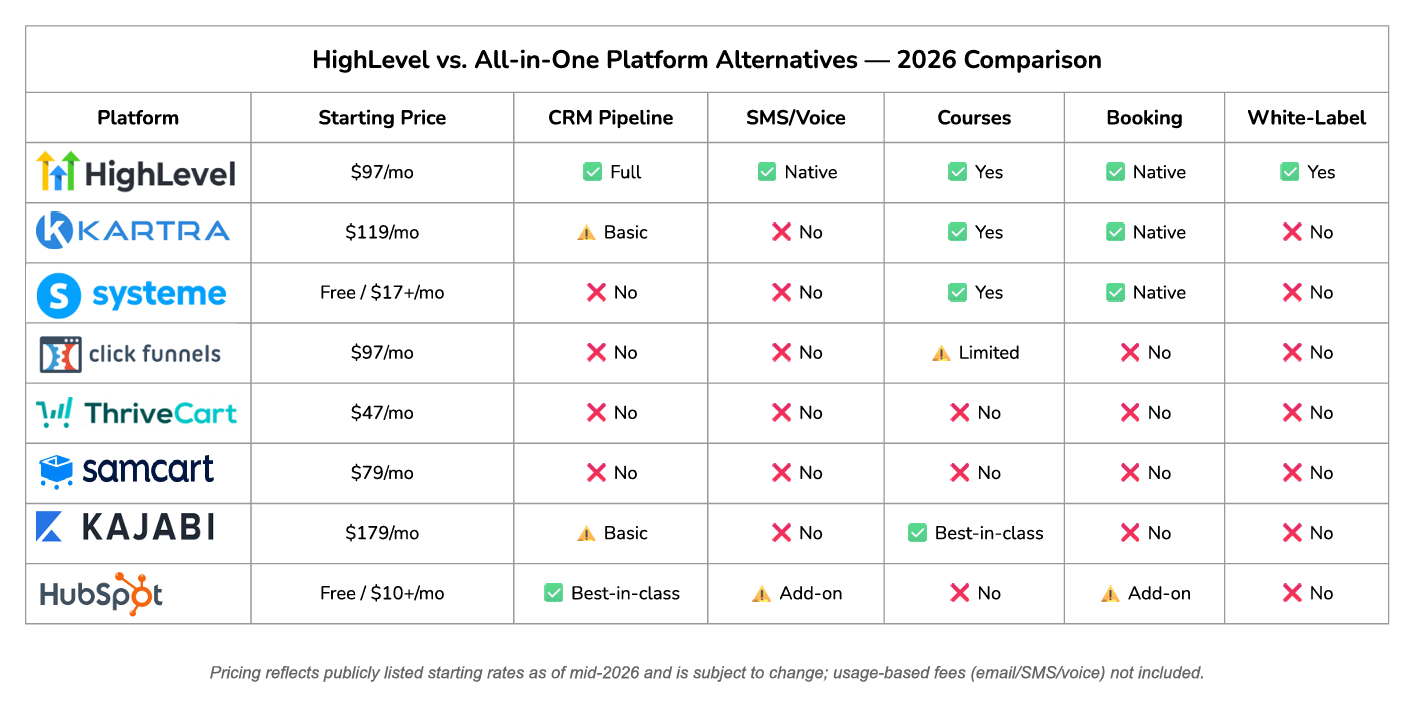
The Comparison at a Glance
Here's the same comparison condensed into a single table. Use it as a quick reference, then scroll back up to whichever section covers the platform you're actually weighing against HighLevel.
So Why Does HighLevel Win?
Simply put, HighLevel is the only platform on this list that checks every box — CRM, funnels, email, SMS, courses, booking, reputation management, for unlimited contacts — without needing to move up to a higher priced tier or an add-on or third-party software bolted on. That's just what the feature list shows when you actually put these platforms side by side.
This matters more than it might seem. Every gap in the table above is a tool you'll need to buy separately, learn separately, and eventually watch break when one of them updates its API and stops talking to the others. For example, you'll see coaches and small business owners having to piece together a Kajabi-plus-ActiveCampaign-plus-Calendly-plus-Zapier stack to run their business the way they want to... and then needing to hire a someone to management their tech stack.
The Honest Problem With HighLevel (and Why "Alternative" Searches Keep Happening)
So, if HighLevel is genuinely the most complete platform, why are so many people searching for "HighLevel Alternative"?
It's not the feature set. It's the experience of getting started. HighLevel was initially built first for agencies with technical teams, not for a solopreneurs and small business owners who just wants to run group programs and book discovery calls.
Setting up HighLevel properly can be intimidating and time-consuming even for people with some technical background, and out of the box, a new HighLevel account is a genuinely blank slate — no pre-built funnels, no configured automations, no snapshot tailored to your specific business model. You're handed one of the most powerful pieces of software in the industry and told to figure it out yourself, usually with support built around ticket queues rather than someone who understands your specific business.
That's not a reason to abandon HighLevel for a weaker platform. It's a reason to stop trying to build HighLevel alone.
The Real HighLevel Alternative: FableForge Suite
If you've read this far, the conclusion should be pretty clear: if you're looking for an all-in-one platform to run your business, HighLevel is the platform to be on.
The real question isn't which platform — it's how you access it. That's exactly what FableForge Suite exists to solve.
What Is FableForge?
FableForge is a done-for-you business software suite built on the HighLevel platform — but pre-configured, customized, and wrapped in genuine human support specifically for coaches, consultants, and course creators.
HighLevel is the powerful engine; FableForge is the guided, customized experience built on top of it.
At $127/month, no hidden fees, cancel anytime, FableForge includes everything HighLevel does well:
- CRM & Lead Management — every contact, conversation, and opportunity tracked in one dashboard
- Marketing & Messaging — email, text, DMs, and social posts from a single platform
- Website & Funnel Builder — a visual, drag-and-drop builder, no developer required
- Bookings & Appointments — client scheduling with automated reminders
- Payments & Sales Tools — offers, checkout pages, and recurring billing in one place
- Courses & Memberships — deliver programs and content from the same platform running your business
- Smart Automations — set-and-forget workflows for follow-up, tagging, and task assignment
- Analytics & Reporting — clear visibility into what's actually working
- Reputation & Reviews — automated review requests and testimonial showcasing
- Bonus tools — chat widgets, missed-call text-back automation, a mobile app, email templates, and branded domains
What FableForge Adds That a Raw HighLevel Signup Doesn't
This is the part that actually matters for anyone comparing platforms:
- Pre-configured tools and templates built for real businesses — you're not staring at an empty dashboard trying to guess where to start
- Expert-built snapshots designed for specific programs and offers — if your coach or program leader works with FableForge, a snapshot can jumpstart your entire setup with pre-built pages, automations, and workflows already in place
- Live office hours and support from real humans who know your context — not a ticket queue, an actual conversation with someone who understands what you're trying to build
- A partner mindset — the platform is built around your success being their success, not just another subscriber number in a churn report
- A tech-implementation community — other coaches and creators working through the same setup challenges, in the same room
If your business already involves a client-facing team, you'll also want to know: FableForge doesn't charge per user, so you can add a coach, VA, or team member to your account at no extra cost.
FableForge Will Even Build Your Website For Free
Here's a detail that tends to surprise people: FableForge will build your entire website for free when you join one of their plans.

This isn't a stripped-down landing page. The free website offer includes six core pages — Home, About, Services, Testimonials, Contact, and a Legal page — built with your actual branding (colors, fonts, logo, content), not a generic template with your name swapped in. Sites are optimized for both traditional SEO and the newer AI-search ("AEO") landscape, and connected to your own domain.
The offer is done only through the free website application here. To qualify for the free website, you need to be on one of the FableForge plans, either:
- Website Only Plan (just $25/month) which includes the professionally built website, hosting, CRM, forms and Weekly live office hours + email support.
- The full FableForge Suite ($127/month) which includes the full all-in-one platform.
For anyone weighing HighLevel against the cost of hiring a web developer — often $3,000–$10,000+ for a business site — this closes a gap that a raw HighLevel signup doesn't address at all. You're not just getting the platform pre-configured; you're getting the first real asset on it built for you.
Who FableForge Is Built For
FableForge makes the most sense if you are:
- A coach, consultant, or course creator who wants one platform that actually runs your whole business, without becoming your second job
- Someone evaluating HighLevel who doesn't want to spend two to four weeks building it from scratch
- A former ClickFunnels, Kajabi, or Kartra user who's tired of a tech stack that's several tools deep and doesn't talk to itself
- Someone who values a real human relationship with their software provider over a support ticket number
- A program leader who wants to hand clients a fully-configured tech system that accelerates their results, rather than adding to their overwhelm
FableForge also runs a Collab Partner program for coaches and consultants who want to give their own clients a done-for-them tech system — creating a new revenue stream while genuinely improving client outcomes. And for anyone who just wants to send referrals, the affiliate program pays recurring commissions, with no subscription required to join.
What Switching to FableForge Actually Looks Like
If you're already on HighLevel, the good news is that switching isn't the disruptive migration people fear. HighLevel allows sub-account transfers between agencies, so an existing account can move over rather than being rebuilt from scratch. It's worth knowing that some agencies use proprietary or asset-protected snapshots that may not transfer, so it's worth a conversation about your specific setup before making the move.
If you're starting fresh, you're not handed a blank screen. FableForge's pre-built templates and configurations mean core pages — opt-ins, sales pages, thank-you pages, booking flows, course portals — can be live quickly, with real people supporting the setup process rather than a documentation library and a hope.
Conclusion: Stop Looking for a Different Platform. Start Looking for a Better Way In.
Every alternative in this guide is a real, capable piece of software. Kartra, Systeme.io, ClickFunnels, ThriveCart, SamCart, Kajabi, and HubSpot each do something well. But none of them match HighLevel's combination of CRM, funnels, multi-channel messaging, automation, booking, courses, and reputation management under a single login — and when you actually lay the feature sets side by side, that gap is hard to argue with.
The real reason people search for a "HighLevel alternative" isn't the software. It's the experience of being handed one of the most powerful platforms in the industry with no map. That's a solvable problem — and it doesn't require leaving HighLevel behind.
If you want the platform that wins the feature comparison, with the pre-built templates, expert snapshots, and real human support that make it actually usable from week one, FableForge Suite is worth a serious look.
Frequently Asked Questions
Is FableForge just HighLevel with a different name?
No. FableForge is built on the HighLevel platform, but it comes pre-configured with templates, automations, and expert-built snapshots designed specifically for coaches, consultants, and course creators, along with live human support and a community — none of which come with a raw HighLevel subscription.
Is HighLevel really better than Kartra, Kajabi, or ClickFunnels?
For a business that needs CRM, multi-channel messaging (email, SMS, and voice), automation, booking, courses, and reputation management all in one platform, yes — HighLevel is the only one on this list that covers all of it natively. Kartra, Kajabi, and ClickFunnels are each strong in narrower categories (funnels, course design, and checkout optimization respectively) but require additional tools to match HighLevel's full feature set.
How long does it take to set up HighLevel from scratch?
Building a new HighLevel account from a blank dashboard commonly takes a couple of weeks or more, depending on technical comfort and how complex your funnels and automations need to be. This is the single biggest reason people go searching for alternatives, and it's the specific problem FableForge's pre-configured setup solves.
Can I migrate my existing HighLevel sub-account to FableForge?
Yes. HighLevel supports sub-account transfers between agencies, and the FableForge team can help facilitate the move. Some proprietary or asset-protected snapshots from a previous agency may not transfer, so it's worth discussing your specific setup first.
Do I need to be technical to use FableForge?
No. The pre-built templates and automations mean you're not starting from scratch, and live office hours plus real human support mean help is available when you get stuck. You don't need a development background to get real results.
What happens to my data if I cancel FableForge?
You own your data and content. Unlike some platforms that lock your work behind an active subscription, FableForge doesn't prevent you from accessing or exporting what you've built if you choose to cancel.