If you've embarked on building your dream business singlehandedly, be your own boss, work how you want and when you want, then you've probably wondered about what it takes to be a successful solopreneur.
I myself took the plunge back in 2020 when I left my engineering career to be a digital solopreneur. Thankfully, I've been able to build a few revenue streams through selling digital products, providing services, smart partnerships, and strategic affiliate marketing.
And over that time, I've learned that handling every aspect of your business on your own, from strategy to execution, can be both exhilarating and daunting. But there are certain things that should be focused on, which I'll share with you in this article, including identifying your core strengths, developing a clear business plan, cultivating a resilient mindset, and establishing efficient systems.
Key Takeaways
Understanding Solopreneurship
Solopreneurship represents a distinct approach to business ownership where individuals build and operate ventures entirely on their own. This path offers unique challenges and rewards that differ significantly from traditional entrepreneurial models.
Defining the Solopreneur Role
A solopreneur is essentially a self-employed individual who runs their business singlehandedly. Unlike traditional entrepreneurs, you'll handle all aspects of your operation without employees. This means you're responsible for product development, marketing, sales, customer service, and administrative tasks.
Solopreneurship revolves around creating a business model that leverages your specific skills and expertise, and typically features:
- Complete autonomy: All decisions and direction come from you
- Personal skill monetization: Your unique talents form the core offerings
- Scalable systems: Successful solopreneurs build processes that don't require constant hands-on management
Your business structure might include digital products, consulting services, content creation, or specialized freelancing. The key distinction is that you intentionally remain the only person directly involved in operations.
Differences Between Solopreneurs and Other Entrepreneurs
While traditional entrepreneurs often focus on building companies with teams, solopreneurs intentionally keep operations contained. This creates several fundamental differences:
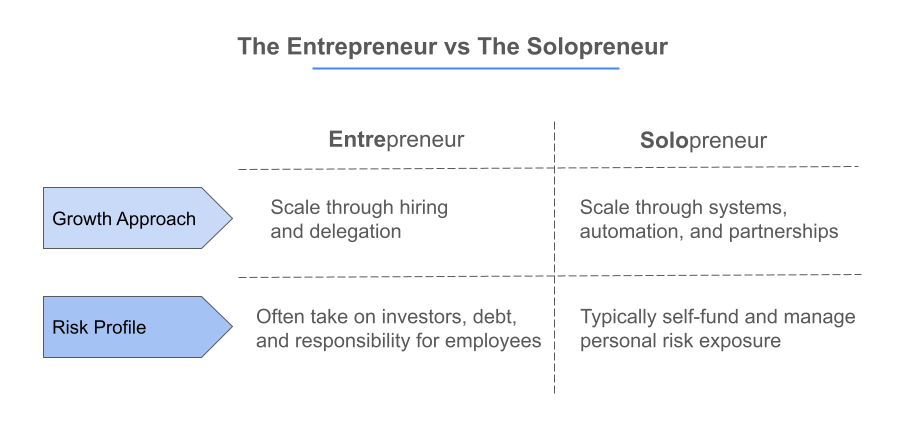
Your startup costs as a solopreneur are generally lower, but your revenue ceiling may be determined by personal capacity limits. This doesn't mean you can't build substantial wealth—many solopreneurs create highly profitable ventures with lean operations and minimal overhead.
The Pros and Cons of Being a Solopreneur
Being a solopreneur offers exciting opportunities but has its challenges. And understanding these realities can help you determine if this path is right for you.
Advantages:
- Complete control: You make every decision about your business direction
- Flexibility: Work when, where, and how you choose
- Higher profit margins: No need to split earnings with partners or investors
- Simplified operations: Fewer moving parts to manage
Challenges:
- Limited bandwidth: Only 24 hours in your day
- Skill gaps: You must learn or outsource functions outside your expertise
- Isolation: Missing team collaboration and support
- Income volatility: You need strategic financial planning to manage inconsistent revenue cycles
Successful solopreneurship requires perseverance through difficult periods. You'll need discipline to maintain momentum when motivation wavers, and resilience to view setbacks as learning opportunities rather than failures.
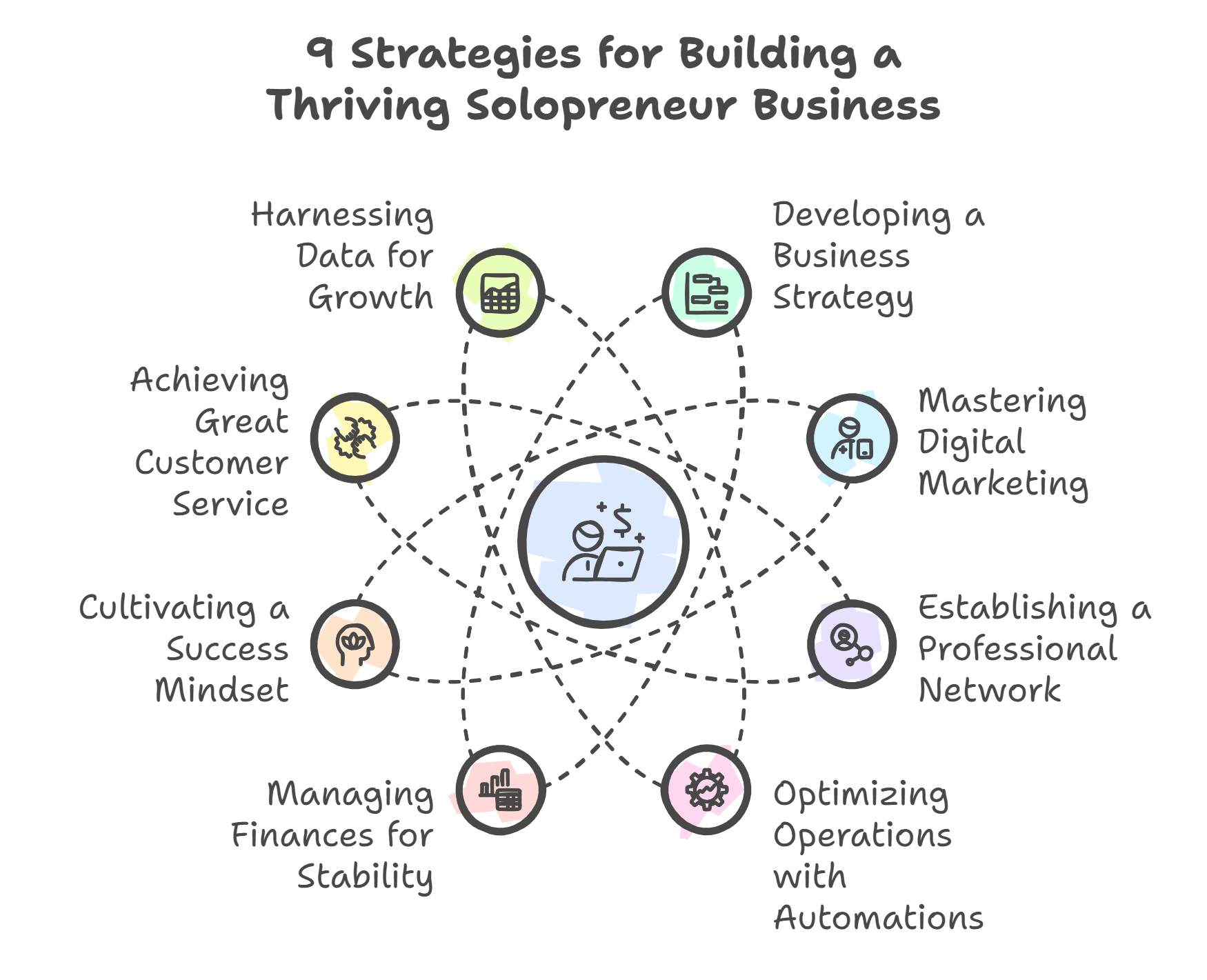
Let's get into 9 essential aspects of building a thriving and sustainable one-person business.
1. Developing a Business Strategy
A solid business strategy serves as your roadmap to your solopreneur success. It helps you identify opportunities, differentiate yourself from competitors, and create sustainable income streams that align with your strengths.
Identifying Your Niche
Finding your perfect niche is the cornerstone of solopreneur success. Start by identifying your strengths – whether it's writing, photography, coaching, or technical skills, etc. – and match them with market demands.
Look for underserved segments where your expertise solves specific problems. Rather than competing in oversaturated markets, seek the intersection of your passion, skills, and profit potential.
Consider these niche identification strategies:
- Passion + Skills + Market Need = Viable Niche
- Specificity trumps generalization (e.g., "fitness coach for busy executives" vs. "fitness coach")
- Research competitors to find gaps you can fill
Test your niche with minimal investment before fully committing. The most profitable niches often serve a defined community with specific, urgent needs.
Crafting a Strong Value Proposition
Your value proposition answers the critical question: "Why should customers choose you over alternatives?" It must communicate clear, specific benefits rather than vague statements.
Effective value propositions contain three key elements:
- The problem you solve
- Your unique solution approach
- Measurable outcomes customers can expect
Use this formula to structure yours:
"I help [target audience] achieve [desired outcome] through [your unique method]."
Validate your value proposition through customer interviews and feedback. Does it address genuine pain points? Is it compelling enough to justify your pricing?
Remember that offering free value initially can demonstrate your expertise and build trust. Your proposition should evolve as you gain market insights and refine your business model.
Building a Unique Brand Identity
Your brand identity distinguishes you in a crowded marketplace and creates emotional connections with customers. It encompasses your visual elements, voice, values, and customer experience.
Start by defining your brand personality traits – are you authoritative, friendly, innovative, or traditional? These characteristics should inform all customer touchpoints.
Your visual identity should include:
- Logo: Simple yet memorable
- Color palette: 2-3 colors reflecting your brand values
- Typography: Consistent across all materials
- Imagery style: Aligned with your audience preferences
Consistency is crucial. Effective branding techniques require using the same visual elements and messaging tone across all channels.
Document your brand guidelines to maintain consistency as you grow. Your authentic voice and consistent presentation will help customers recognize and remember you among competitors.
Create a Scalable Business
Your business model, your systems and your tools should all be scalable. It’s better to start with scalable tools now, rather than have to scramble and switch them once your business takes off.
For example, check your email service provider. Will it work when you grow your subscriber list to 100,000 or more? What about your webhost? Will it grow with you as your traffic grows?

PRO TIP: If you've been struggling for years as an entrepreneur (invested so much time, effort and money) trying to build a dream business that's sustainable, profitable and scalable that you truly love (or fix your existing business), then the BLUEprint Business Design Workshop with Business Design Consultant Christina Hooper may just be the workshop for you.
2. Mastering Digital Marketing
Digital marketing offers solopreneurs powerful strategies to attract clients and build their business without massive advertising budgets. The right strategies can vastly improve your visibility and establish you as an authority in your niche.
Creating an Online Presence
Create an effective online presence by firstly establishing a strong personal brand that clearly communicates your unique value proposition.
Your website serves as your digital headquarters—make it professional, mobile-friendly, and optimized for search engines.
Choose 1-2 social media platforms where your target audience spends time rather than spreading yourself too thin across all channels. Consistency matters more than quantity.
Make SEO (search engine optimization) a priority by researching relevant keywords for your industry. Incorporate these naturally throughout your website content to improve organic traffic.
Google My Business is essential if you serve local clients. Complete your profile with accurate information, high-quality photos, and encourage satisfied clients to leave reviews.
Monitor your online reputation regularly. Set up Google Alerts for your name and business to stay informed about what people are saying about your business online.
Leveraging Content Creation
Content creation establishes your expertise and drives organic traffic to your business. Identify your target audience and create detailed buyer personas before producing any content.
Here again you should focus on quality over quantity. One exceptional piece that solves a specific problem for your audience outperforms multiple mediocre posts.
Content types to consider:
- Blog posts addressing common questions in your field
- Video tutorials demonstrating your expertise
- Podcasts interviewing industry leaders
- Infographics summarizing complex information
Repurpose content across multiple channels to maximize your effort. A single blog post can become a video, social media posts, and an email newsletter.
Set up a content calendar to maintain consistency. Even posting once weekly is sufficient if you maintain quality and relevance to your audience's needs.
Email Marketing Strategies
Email marketing remains one of the most effective digital marketing strategies for solopreneurs with its impressive ROI. Start building your email list from day one with compelling lead magnets.
Segment your email list based on interests, behavior, or demographics. This allows you to send highly relevant content that resonates with specific audience groups.
Keep your emails concise with a single clear call-to-action. Overwhelming subscribers with multiple requests reduces effectiveness.
Test different subject lines, send times, and content formats to discover what works best for your audience. Most email marketing platforms offer A/B testing features.
Automate welcome sequences, follow-ups, and nurture campaigns to save time while maintaining regular contact with prospects. This keeps your business top-of-mind without requiring constant attention.
Focus on providing value in every email rather than constant selling. The 80/20 rule works well—80% valuable content, 20% promotional content.
PRO TIP: To improve your digital marketing knowledge and skills consider subscribing to DigitalMarketer's free weekly newsletter (DM Insider). You'll get actionable, tactical, and timely tips plus access to their library of marketing guides, reports, tools, templates and more.
3. Establishing a Professional Network
A solid professional network serves as a cornerstone for solopreneur success, providing opportunities for collaboration, support, and growth. Effective networking requires strategic planning and genuine relationship building to create valuable connections that help your business thrive.
Building Meaningful Relationships
Prioritizing time for establishing and nurturing mutually beneficial relationships is essential for solopreneurs. Don't approach networking with a "what can I get" mindset; instead, focus on how you can provide value to others first.
Attend industry events, conferences, and meetups where you can connect with like-minded professionals. These in-person interactions often create stronger impressions than digital connections alone.
Consider joining professional organizations or online communities specific to your industry. These groups provide regular opportunities to engage with peers facing similar challenges.
Use social media strategically by participating in relevant discussions and sharing valuable insights.
Remember that quality trumps quantity when building your network. A few deep, meaningful connections often provide more value than hundreds of surface-level acquaintances.
Collaborating with Freelancers and Outsourcing
Even though you’re a solopreneur, that doesn’t mean you need to do everything yourself. You can grow your business more quickly, free up your time to work on other tasks, and/or enjoy more leisure time if you outsource.
Begin by assessing your strengths and weaknesses. Consider these questions when deciding what to outsource:
- What are your low-value tasks?
- Which tasks could a freelancer do more quickly than you?
- Which tasks could a freelancer do better than you?
- Which tasks do you dread (e.g., maybe you procrastinate when you have to do a particular task)?
Outsource tasks that fall outside your expertise or that consume disproportionate amounts of your time.
When selecting collaborators, look beyond technical skills. Find freelancers whose communication styles and work ethics align with your expectations. Start with small projects to test working relationships before committing to larger engagements. This approach minimizes risk while allowing you to find reliable partners for long-term collaboration.
4. Optimizing Operations with Automation
Automation serves as the backbone for successful solopreneurs who want to scale their business while maintaining work-life balance. Strategic implementation of automated systems can dramatically reduce your workload while increasing efficiency.
Streamlining Workflows
As a solopreneur, your time is your most valuable asset. Prioritizing both routine and one-off tasks is essential before you can streamline them effectively. Start by mapping out your current processes to identify bottlenecks and time-drains.
Project management tools like Trello, Asana, or ClickUp can transform scattered tasks into organized workflows. Set up templates for recurring projects to eliminate repetitive setup time.
Consider implementing standard operating procedures (SOPs) for your most common activities. These documented processes also make it easier to outsource tasks when you're ready to expand.
Client onboarding is an excellent candidate for streamlining. Create automated email sequences and intake forms that gather all necessary information upfront, thereby reducing back-and-forth communications.
Automating Repetitive Tasks
Automation has been instrumental in enabling solopreneurs to run highly competitive businesses by eliminating manual work.
- Email marketing automation can nurture leads while you focus on other priorities.
- Social media scheduling tools allow you to maintain an active online presence without manual daily posting. Batch create content monthly, then schedule it to drip out automatically. Blaze AI is a great AI automated content marketing platform that plans, creates, schedules and automatically publishes your content on social media.
- Invoicing and payment collection can be fully automated using tools like QuickBooks or FreshBooks. Set up recurring billing for subscription-based services to ensure consistent cash flow.
- Platforms like Zapier and Pabbly can connect your various platforms, creating powerful automation workflows between them. For example, new form submissions can automatically create tasks in your project management system.
Successful solopreneurs leverage such automation tools to focus on growth rather than maintenance tasks.
5. Managing Finances for Stability
Maintaining proper financial practices helps you weather unexpected challenges while positioning your business for sustainable growth.
Keeping Accurate Financial Records
Accurate financial record-keeping is non-negotiable for solopreneurs. Set up a dedicated business bank account to separate personal and business finances, making tax preparation and expense tracking significantly easier.
Invest in user-friendly accounting software like QuickBooks, FreshBooks, or Wave to automate business operations. These tools can generate financial reports, track expenses, and send professional invoices with minimal effort.
Create a simple system for organizing receipts and financial documents. Digital storage solutions provide backup and easy retrieval when needed for tax preparation or financial analysis.
Quick Monthly Financial Review Checklist
Consistent record-keeping helps identify tax deductions and prevents costly errors during tax season.
Budgeting for Growth and Stability
Effective budgeting provides the framework for financial stability. Start by listing all income sources and categorizing expenses as fixed (rent, software subscriptions) or variable (marketing, supplies).
Create a realistic budget that includes:
- Emergency fund: Aim to save 3-6 months of operating expenses
- Tax reserve: Set aside 25-30% of income for quarterly tax payments
- Business development: Allocate funds for growth opportunities
- Personal salary: Pay yourself consistently
Implement the 50/30/20 rule: 50% for essential business expenses, 30% for growth initiatives, and 20% for savings and contingencies.
Review your budget quarterly and adjust based on business performance. This practice helps you make informed financial decisions and identify areas where you can cut costs or increase investment.
Use cash flow management strategies like staggered billing cycles and upfront deposits to maintain steady income throughout the month.
6. Cultivating a Success Mindset
Your mindset sits at the foundation for your solopreneur journey, directly influencing your ability to overcome challenges and recognize opportunities. The way you think shapes every business decision you make and determines how effectively you navigate the inevitable ups and downs.
Hold Yourself Accountable
It’s easy to let things slide when you’re a solopreneur because no one is breathing down your neck or hounding you to get things done. And that’s why you need to hold yourself accountable. You can do that by:
- Writing down your goals.
- Telling other supportive people about your goals.
- Getting an accountability partner to help you achieve your goals.
In addition, if you find yourself procrastinating, you’ll want to examine why that is. Sometimes simply shining a light on the reason will help you get moving again.
Maintaining Motivation and Passion
Motivation is the fuel that keeps your solopreneur journey moving forward. To maintain it, connect daily tasks to your larger purpose and vision. Ask yourself regularly: "Why did I start this business in the first place?"
Create a passion inventory by listing the aspects of your work that genuinely excite you and schedule these energizing activities strategically throughout your week to prevent burnout.
Establish small, achievable milestones to celebrate along the way. These victories build momentum and provide tangible evidence of your progress, which is essential when you're working alone.
During challenging periods, cultivating a success mindset means practicing resilience through consistency. Develop morning routines that set a positive tone and evening reflections that acknowledge your daily achievements, no matter how small.
Fostering Creativity and Innovation
Set aside dedicated time for brainstorming without judgment or limitations—what some call "blue sky thinking".
Innovation practices you can implement:
- Schedule weekly "curiosity hours" to explore industry trends
- Cross-pollinate ideas from different industries
- Document all ideas, even ones that seem impractical initially
- Create physical distance from your work environment to gain new perspectives
Adopt a risk-taking mindset that views failures as valuable learning opportunities rather than setbacks. Remember that creativity often emerges when you push beyond your comfort zone.
Develop systems to capture inspirations whenever they strike. Keep a digital or physical idea journal accessible at all times to prevent losing potentially transformative insights.
Building Confidence through Leadership
As a solopreneur, you must be able to lead yourself. Confidence comes from demonstrating courage in decision-making and taking consistent action despite uncertainty.
Track your accomplishments meticulously to combat impostor syndrome. Create a "wins document" where you record positive feedback, successful projects, and obstacles overcome.
Confidence-building strategies you can adopt:
- Practice decisive action even with incomplete information
- Develop expertise through continuous learning
- Surround yourself with supportive peers
- Set boundaries with clients and collaborators
Recognize that aspiring solopreneurs are among the most ambitious people, driven by a genuine passion for their work. Your confidence will naturally grow as you accumulate experiences and overcome challenges that once seemed insurmountable. View leadership as service—to your clients, your industry, and your own vision. This perspective shifts focus from self-doubt to the value you provide.
Invest In Your Education
As a solopreneur, you need to know a lot about quite a few different topics, including marketing, copywriting, advertising, business management, accounting, customer retention, customer relations and so on. You’ll want to invest in yourself and invest in your education by finding the best information and coaches to help you acquire the information and skills you need to succeed. Be sure to set aside time every week for your studies.
7. Providing Great Customer Service
Customer service excellence can make or break your solopreneur business. Great customer service establishes trust, encourages repeat business, and turns clients into advocates for your brand.
Understanding the Target Market
Knowing who your customers are forms the foundation of exceptional service. Take time to research demographics, preferences, and pain points of your ideal clients.
Create detailed buyer personas to visualize exactly who you're serving. This clarity allows you to customize your approach and marketing messages to resonate with their specific needs.
Listen actively to feedback through surveys, direct conversations, and social media monitoring. What frustrates them about your industry? What delights them?
Quick Market Research Methods:
- Conduct short customer interviews
- Analyze competitors' reviews
- Monitor industry forums and social media groups
- Test different messaging with small audience segments
Delivering Consistent Value
Consistency builds reputation and client confidence. Setting regular check-ins with clients ensures you stay aligned with their expectations and can address concerns promptly.
Create systems that maintain quality even when you're busy. Develop templates, checklists, and standard operating procedures to ensure nothing falls through the cracks.
Be transparent about what clients can expect. Clearly communicate timelines, deliverables, and boundaries to prevent misunderstandings.
Value-Building Tactics:
- Provide unexpected "extras" that enhance the client experience
- Follow up after project completion to ensure satisfaction
- Create shareable checklists for you and your clients
- Establish clear communication channels and response timeframes
Remember that your reputation as a solopreneur hinges on each customer interaction. When you treat every client touchpoint as an opportunity to demonstrate excellence, you build a business that thrives on referrals and repeat business.
8. Harnessing Data for Growth
Your business generates valuable information daily that can be used for data-driven decision-making which fuels strategic growth when properly analyzed.
Analyzing Customer Data
Customer data reveals crucial insights about your business performance and opportunities. Start by collecting basic metrics like conversion rates, customer acquisition costs, and lifetime value through your website analytics, CRM tool, email marketing platform or ecommerce checkout platform.
Look for patterns in your best customers:
- Which products do they purchase most?
- How did they find your business?
- What characteristics do they share?
Set up a simple spreadsheet to track these metrics weekly. The Metrics Maven podcast offers guidance specifically for solopreneurs on which metrics matter most for growth.
Use A/B testing to experiment with different approaches based on your findings. For example, if data shows customers respond better to video content, shift your marketing accordingly.
Customer feedback is gold - create a system to regularly collect and analyze testimonials, surveys, and direct comments to identify improvement areas.
Adjusting to Market Trends
Market awareness keeps your offerings relevant and competitive. Set up Google Alerts for industry keywords and subscribe to trade publications to stay informed about emerging trends.
Analyze your competitors quarterly:
- What new products/services are they offering?
- How are their prices changing?
- What messaging are they using in marketing?
Successful entrepreneurs understand that market data becomes a powerful growth engine when consistently applied to business decisions.
Use tools like Google Trends to identify growing search terms in your niche. This simple tactic can inform your content creation, product development, and marketing strategy all at once.
Remember that data analysis doesn't require complex systems as a solopreneur. As highlighted by business experts, even simple analysis can become your secret weapon for growth when applied consistently.
9. Enhancing Productivity and Time Management
Mastering your time and productivity forms the backbone of solopreneur success. The right strategies will help you accomplish more meaningful work while maintaining your wellbeing and business growth.
Set Clear Goals
You can start by thinking long-term about where you want your business to be in 1-5 years. Then you can work backwards from that to define your monthly, weekly and even daily to-do lists and goals.
NOTE: Just be sure you’re setting SMART goals, which stands for:
- Specific
- Measurable
- Achievable
- Relevant
- Time-bound
For example, setting a milestone goal such as, “I want to increase my mailing list size” isn’t a SMART goal. Instead, you’d create a goal along the lines of, “I want to increase my mailing list size by 5000 targeted subscribers within six months from today.”
Define Your Boundaries
When you’re a solopreneur, your life and work boundaries can become blurred. For example, you might be sitting on the couch in the evenings enjoying time with the family, but then you decide to check your email or take a look at your analytics. Or on the flip side, you might be sitting down to work, and instead you find yourself texting with a friend.
It happens so easily. That’s why you’re going to want to set firm life and work boundaries. For example:
- Set how many hours you work per day.
- Determine exactly what time you’re done each day.
- Draw boundaries around your family/friend/personal time – e.g., no answering the work phone if it rings, no answering work emails or texts, etc.
You’re going to want to write down your boundaries and adjust them as needed if you see any issues. In some cases, you’ll need to use your best judgment. For example, if you like to read before bed, will you allow yourself to read “work stuff?” Or is your reading time for pleasure only? (There’s no right or wrong here. These are your boundaries, your business, your life.)
Create a Daily Routine
As mentioned before, you can choose your goals and then create to-do lists based on your goals. You’ll also want to create a daily routine to help you achieve everything on your daily to-do lists.
Follow these tips:
- Block off time on your calendar as dedicated work time.
- Craft a daily to-do list, being sure to prioritize tasks that are both urgent and important.
- Create a pre-work routine to get in the work mindset, such as pouring yourself a cup of coffee and reviewing your to-do list before your actual work time begins.
- Group similar tasks together.
- Schedule time for checking email or social media (so that you only do these things a couple times per day, rather than doing it constantly).
- Turn off distracting items such as push notifications or turn the entire phone off if you can.
- Block online distractions if needed (such as by using GetColdTurkey.com).
Prioritizing Tasks Effectively
Start each day by identifying your most important tasks. Ruthlessly prioritizing tasks ensures you focus on high-impact activities that drive your business forward. Use techniques like the Eisenhower Matrix to categorize tasks by urgency and importance.
Create a structured to-do list that covers all areas of your life and business. This practice helps you stay organized and prevents important tasks from falling through the cracks.
Block time for deep work sessions when tackling complex projects. During these periods, eliminate distractions by turning off notifications and using focus apps if necessary.
Know when to say no to opportunities that don't align with your goals. Every "yes" to a new commitment means saying "no" to something else.
Adapting to Changing Circumstances
Flexibility is crucial for solopreneurs. Build buffer time into your schedule to accommodate unexpected challenges or opportunities without derailing your entire day.
Switch up your workspace when you feel productivity slipping. A change of environment can stimulate creativity and renew focus.
Incorporate regular breaks using techniques like the Pomodoro Method (25 minutes of work followed by a 5-minute break). These intervals prevent burnout and maintain consistent productivity throughout the day.
Review and adjust your systems weekly. What worked last month might not be optimal now. Be willing to experiment with new productivity tools and workflows as your business evolves.
Work in a cool, comfortable environment to maintain energy levels and focus during long workdays.
Conclusion
Being a successful solopreneur requires that you wear multiple hats while maintaining focus on your goals and core strengths. By implementing these strategies, you can build a sustainable, fulfilling business that aligns with your values and goals, all while enjoying the freedom and flexibility that solopreneurship offers.
The path isn't always linear, and perseverance through challenges is what separates successful solopreneurs from those who give up too soon. By focusing on providing genuine value to your customers while maintaining a balanced approach to growth, you can create a business that supports both your financial goals and personal fulfillment.
What step will you take today to move your solopreneur journey forward?